Visualizing Learning: The Role of School Education and Science Background in Modern Design
In the rapidly evolving landscape of educational technology and curriculum development, the visual representation of learning has become just as critical as the content itself. When educators, designers, and administrators discuss the School Education and Science Background, they are often referring to more than just a physical setting or a theoretical framework. They are talking about the aesthetic and conceptual environment that fosters curiosity, engagement, and understanding. This is where the intersection of pedagogical theory and graphic design creates a powerful synergy, particularly through the use of hand-drawn vector symbols, doodle-style illustrations, and sticker-like graphics.
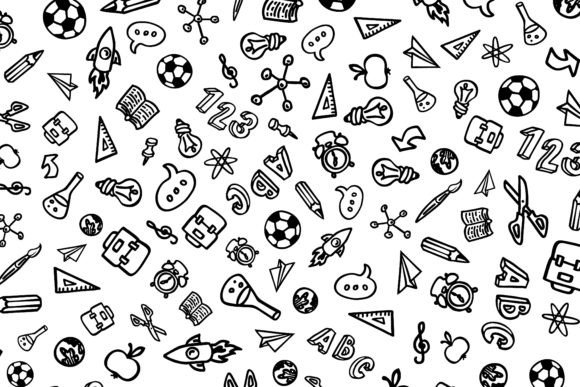
The concept of a School Education and Science Background serves as a foundational element in creating materials that resonate with students across various age groups. Whether it is for a primary school classroom wall, a digital learning platform, or promotional material for Teacher’s Day, the visual language used must be inviting, clear, and intellectually stimulating. Seamless patterns featuring doodles of school supplies, scientific instruments, and educational icons are not merely decorative; they are functional tools that help contextualize learning.
The Psychology Behind Doodle-Style Educational Graphics
Why do hand-drawn vector symbols and objects work so well in educational settings? The answer lies in cognitive load theory and emotional engagement. Traditional, rigid photography or overly complex diagrams can sometimes intimidate younger learners or feel sterile to older students. In contrast, sticker style drawings and seamless patterns with doodles offer a approachable, human touch. They mimic the natural way students interact with their notebooks—scribbling ideas, drawing margins, and personalizing their space.
When we integrate a School Education and Science Background into project designs, we are leveraging this psychological comfort. A background filled with playful yet accurate representations of beakers, microscopes, books, and pencils signals to the learner that science and education are accessible activities. It reduces anxiety and promotes a growth mindset. For instance, a biology textbook chapter on cell structure becomes less daunting when surrounded by whimsical, hand-drawn borders of leaves and test tubes rather than stark, clinical imagery.
Key Elements of Effective Educational Doodles
To effectively utilize these assets, one must understand what constitutes a high-quality educational doodle set. The best collections balance accuracy with artistic flair. Here are the essential components that make these graphics effective:
- Recognizability: Even in a simplified, sticker-style format, a microscope must look like a microscope, and a globe must be identifiable. Ambiguity can lead to confusion, which defeats the purpose of visual aids.
- Versatility: The graphics should work in both color and monochrome. This allows teachers to print materials cost-effectively while still maintaining visual interest.
- Scalability: Since these are often vector-based (SVG, AI, EPS), they must retain clarity whether used as a small icon in a mobile app or a large backdrop for a school auditorium stage.
- Thematic Cohesion: A seamless pattern should feel unified. Mixing overly realistic scientific diagrams with cartoonish school buses can create visual dissonance. The style must remain consistent throughout the School Education and Science Background.
Practical Applications in Modern Workflows
The utility of these design assets extends far beyond simple decoration. In modern educational workflows, content creators, instructional designers, and marketing teams rely on flexible graphic resources to speed up production without sacrificing quality. The availability of files in multiple formats—SVG, Ai, Eps, JPG, PNG—ensures that these doodles can be integrated into virtually any project pipeline.
Consider the scenario of a school preparing for Teacher’s Day. The communications team needs to produce banners, social media posts, greeting cards, and presentation slides. Using a cohesive set of hand-drawn vector symbols allows them to maintain a consistent brand identity across all mediums. They can use the SVG files for web animations, the EPS files for large-format printing, and the PNGs for quick digital overlays. This flexibility saves time and ensures that the message of appreciation is delivered through a visually appealing and professional lens.
Furthermore, in the realm of e-learning, user interface (UI) designers use these seamless patterns to create engaging backgrounds for course modules. A chemistry course might feature a subtle, repeating pattern of molecular structures and lab equipment. This reinforces the subject matter subconsciously, keeping the student immersed in the topic without overwhelming them with text-heavy screens.
Bridging the Gap Between Art and Science
One of the most profound benefits of incorporating a School Education and Science Background into visual projects is the bridging of the perceived gap between art and science. Historically, these disciplines have been treated as separate silos. However, modern STEM (Science, Technology, Engineering, and Mathematics) education increasingly emphasizes STEAM, adding Arts into the mix.
Doodle-style drawings are inherently artistic. They require creativity, line weight variation, and compositional balance. When these artistic elements are used to represent scientific concepts—such as drawing a stylized DNA helix or a quirky robot—they demonstrate that science is a creative endeavor. This perspective is crucial for encouraging diverse students to pursue scientific fields. It shows that innovation requires both analytical thinking and creative visualization.
For designers working on educational products, this means paying attention to the details. A well-drawn atom should not only be scientifically accurate in its electron shell representation but also aesthetically pleasing. The lines should flow naturally, and the colors should be harmonious. This attention to detail elevates the perceived value of the educational material, making it more likely to be adopted by schools and appreciated by students.
Choosing the Right Assets for Your Project
With countless resources available online, selecting the right School Education and Science Background assets requires careful consideration. Not all doodle sets are created equal. Here are some factors to evaluate before downloading or purchasing:
- License Terms: Ensure the assets are licensed for your intended use, whether commercial or personal. Many high-quality vector packs offer broad usage rights, but it is always wise to double-check.
- File Organization: A well-organized file structure saves hours of work. Look for packs where layers are named logically in AI and EPS files, and where SVG code is clean and optimized for web use.
- Style Consistency: Check if the stroke widths and corner styles are uniform across all icons. Inconsistent line weights can make a design look amateurish.
- Cultural Relevance: Ensure the symbols used are universally understood or appropriate for your target audience. For example, certain school supplies may vary by region, so a global audience might require more generic icons.
Additionally, consider the color palette. While black-and-white outlines are versatile, having pre-colored versions in vibrant, educational-friendly hues can accelerate the design process. Colors like blue, green, and yellow are often associated with trust, growth, and energy, respectively, making them ideal for educational contexts.
The Future of Educational Visuals
As we move further into a digital-first era, the demand for high-quality, scalable, and engaging visual content will only grow. The School Education and Science Background is no longer just a static image; it is an interactive element. With the rise of augmented reality (AR) in classrooms, these vector doodles can become 3D objects that students can manipulate. A hand-drawn planet can pop off the page, allowing students to explore its surface.
This evolution underscores the importance of starting with strong, clean vector foundations. If the initial 2D design is cluttered or poorly constructed, it will not translate well into 3D or interactive formats. Therefore, investing in high-quality, professionally designed doodle sets is a future-proof strategy for educational institutions and content creators alike.
In conclusion, the integration of hand-drawn vector symbols, seamless patterns, and sticker-style drawings into educational materials is a powerful tool for enhancing engagement and comprehension. By carefully selecting and applying these assets, designers and educators can create a School Education and Science Background that is not only visually appealing but also pedagogically sound. Whether for a simple classroom poster or a complex e-learning module, these elements bring warmth, clarity, and creativity to the world of learning, making science and education accessible and enjoyable for all.