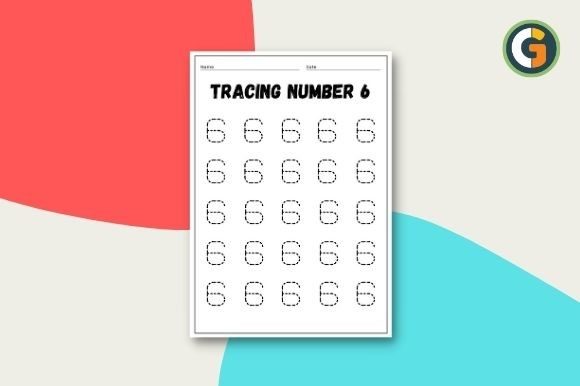
Tracing Number Worksheets: A Practical Guide for Early Learning
Early childhood education relies heavily on the development of fine motor skills and number recognition. Among the various tools available to educators and parents, tracing number activities stand out as a foundational method for introducing numerical concepts. These worksheets are not merely busy work; they serve as a critical bridge between visual recognition and the physical ability to write. For those evaluating educational resources, understanding the specific role of tracing exercises, particularly focused tasks like the tracing number 6 worksheet, is essential for making informed decisions about curriculum support.
Understanding the Role of Tracing in Numeracy
At its core, a tracing number exercise involves providing a child with a dotted or faint outline of a numeral, which they then trace over using a pencil, crayon, or marker. This process helps internalize the shape and formation of each digit. Unlike freehand writing, which requires significant cognitive load regarding both form and meaning, tracing reduces the complexity by focusing primarily on motor execution.
Parents and teachers often turn to these materials when a child shows interest in numbers but struggles with the physical act of writing them. The structured nature of these worksheets provides immediate feedback. If a child stays within the lines, they receive visual confirmation of correct formation. This repetition builds muscle memory, allowing the brain to associate the physical movement with the symbolic representation of the quantity.
Evaluating the Benefits and Tradeoffs
When considering whether to integrate extensive tracing practice into a learning routine, it is important to weigh the advantages against potential limitations. The primary benefit is the development of fine motor control. Holding a writing instrument and navigating the curves and lines of a number strengthens the small muscles in the hand and fingers. This dexterity is crucial not only for handwriting but also for other daily tasks.
Furthermore, tracing number activities reinforce number identification. As children repeatedly trace digits from 0 to 9, they become more familiar with the unique characteristics of each symbol. For instance, distinguishing between a 6 and a 9 can be challenging for young learners. Focused practice helps clarify these differences.
However, there are tradeoffs. Over-reliance on tracing can sometimes hinder the transition to independent writing. If a child becomes too dependent on the visual guide, they may struggle when asked to write numbers without assistance. Additionally, repetitive tracing can become monotonous, potentially leading to disengagement if not balanced with other interactive activities. It is vital to view these worksheets as one component of a broader numeracy strategy rather than a standalone solution.
The Specific Value of Targeted Practice: The Number 6
While general number tracing is beneficial, targeted worksheets offer distinct advantages for addressing specific learning hurdles. Consider the tracing number 6 worksheet. The number 6 presents a unique challenge because it involves a continuous curved motion that loops back on itself. Many children initially confuse the directionality, starting from the bottom instead of the top, or mixing it up with the number 9.
A dedicated worksheet for this digit allows for concentrated practice on this specific motor pattern. By isolating the number 6, educators can provide verbal cues and physical guidance tailored to that shape. For example, instructions might include "start at the top, curve around, and close the loop." This level of specificity is difficult to achieve in a mixed-number worksheet where attention is divided among ten different shapes. For parents observing consistent errors with a particular digit, selecting a focused resource is a logical and effective intervention.
When Tracing Worksheets Are a Strong Fit
These tools are particularly effective in several scenarios. First, they are ideal for beginners who are just being introduced to formal writing. Children aged three to five often possess the cognitive ability to recognize numbers but lack the manual dexterity to form them correctly. Tracing provides the necessary scaffolding.
Second, they are useful for children who need structured routine. Some learners thrive on predictability and clear expectations. A worksheet provides a defined task with a clear beginning and end, which can reduce anxiety and increase focus. Third, they are valuable for reinforcing learning outside the classroom. Parents looking for quiet, screen-free activities that support school curriculum goals will find these worksheets practical and easy to implement at home.
Considering Alternatives and Complementary Methods
While tracing number worksheets are effective, they are not the only method for teaching numeracy. In situations where a child shows signs of frustration or boredom with paper-based tasks, alternatives may be worth considering. Multisensory approaches, such as forming numbers with playdough, drawing in sand, or using magnetic tiles, engage different sensory pathways and can be more engaging for kinesthetic learners.
Additionally, digital apps and interactive games offer immediate auditory and visual feedback that static worksheets cannot provide. For children who are highly tech-oriented, these platforms might maintain engagement longer. However, these alternatives often lack the tactile experience of holding a pencil, which is crucial for developing the specific grip and pressure control needed for school-ready handwriting. Therefore, a blended approach is often recommended. Use tracing worksheets to build precision and muscle memory, while incorporating multisensory activities to maintain interest and deepen conceptual understanding.
Practical Decision-Making Insights for Parents and Educators
When selecting tracing number resources, consider the quality of the design. Look for worksheets that use clear, large fonts with adequate spacing. The dotted lines should be distinct enough to guide but not so bold that they distract from the child’s own mark. Paper quality also matters; thicker paper prevents pencil bleed-through and withstands erasing, which is a common part of the learning process.
It is also important to monitor progress. If a child consistently traces accurately, it may be time to introduce partial tracing, where only part of the number is dotted, or eventually, blank boxes for independent writing. Conversely, if a child struggles, revert to larger formats or use finger tracing before introducing a pencil. The goal is gradual independence.
Ultimately, the decision to use these worksheets should align with the child’s current developmental stage and learning style. They are a tool, not a mandate. Observe how the child responds. Do they seem confident? Are they improving in their freehand attempts? If the answer is yes, the tool is working. If not, reassess the approach and consider integrating more playful or multisensory methods.
In conclusion, tracing number activities, including specialized sheets like the tracing number 6 worksheet, play a significant role in early math education. They offer a structured, low-cost, and effective way to build fine motor skills and number recognition. By understanding their benefits, limitations, and appropriate applications, parents and educators can make informed choices that best support a child’s journey toward numeracy and handwriting proficiency.