Understanding States of Matter and Changes in Them: A Visual Guide for Young Learners
Matter is everything that we come across in our lives, like the air we breathe in, our furniture, what we eat– and the list goes on. All living things and also non-living things are examples of matter. For adults, this concept is second nature, but for a child taking their first steps into scientific inquiry, the idea that a solid rock, liquid water, and invisible air are all fundamentally the same "stuff" can be mind-bending. This quick introduction file helps kids grasp the principles and basics about states of matter.
Teaching science to early learners requires more than just definitions; it requires engagement. Traditional textbooks often rely on dense text and static diagrams that fail to capture the imagination of a five-year-old. This is where specialized educational resources become invaluable. By combining clear explanations with artistic visuals, educators and parents can transform abstract concepts into tangible knowledge.
The Foundation of Early Science Education
Introducing the concept of matter to kindergarten, preschool, or primary school-aged children sets the stage for future scientific literacy. However, the method of delivery is crucial. If the material is too dry, children disengage. If it is too complex, they become frustrated. The sweet spot lies in resources that balance accuracy with accessibility.
This PDF file is perfect for these young demographics to introduce states of matter and changes in states of matter. It serves not merely as a reading assignment but as a visual journey. To make it more appealing to children, colourful watercolour images accompany the descriptions, making it picture book-like. This aesthetic choice is deliberate. Watercolours are soft, inviting, and less intimidating than stark technical illustrations, creating a warm learning environment that encourages curiosity rather than rote memorization.
Why Visuals Matter in Learning Physics
Children are visual learners. When explaining that ice melts into water and water evaporates into steam, words alone can feel abstract. Seeing a beautifully rendered watercolour illustration of an ice cube transitioning into a puddle, and then into wispy clouds, helps bridge the gap between theory and reality. These visuals act as cognitive anchors, helping young minds retain information by associating scientific terms with memorable images.
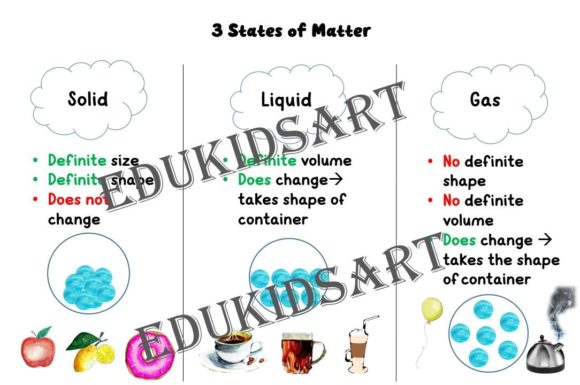
- Solid: Represented by structured, defined shapes like blocks or ice cubes.
- Liquid: Depicted with flowing, organic forms like rivers or rain.
- Gas: Illustrated with soft, diffuse textures like steam or clouds.
By using such distinct visual cues, the resource ensures that children can differentiate between the three primary states of matter intuitively. This approach aligns with modern pedagogical strategies that emphasize multi-sensory learning experiences.
Exploring the Content: What’s Inside?
The core value of this educational material lies in its simplicity and focus. It does not overwhelm the learner with excessive data. Instead, it breaks down the topic of States of Matter and Changes in Them into digestible segments. Each section is designed to build upon the previous one, creating a logical flow that mirrors the natural way children ask questions.
- Definition of Matter: Starting with the basics, explaining that anything taking up space is matter.
- The Three States: Detailed yet simple explanations of solids, liquids, and gases.
- Transitions: How heat and cold cause matter to change from one state to another.
- Real-World Examples: Connecting the science to everyday objects like ice cream, boiling kettles, and balloons.
This structure ensures that by the end of the document, the child has not only memorized terms but understands the underlying mechanisms of change. The inclusion of real-world scenarios makes the science relevant. For instance, explaining why a puddle disappears after a sunny day helps connect the concept of evaporation to their daily observations.
The Role of EdukidsArt in Educational Resources
Creating high-quality educational materials is a niche that requires both artistic talent and pedagogical understanding. Extra note: EdukidsArt aims to provide affordable, educational, unique as well as visually appealing watercolour clipart as well as educational material for all occasions. This mission statement highlights a critical gap in the market: the need for resources that are both aesthetically pleasing and educationally rigorous.
Many free resources available online lack the polish required to keep children engaged, while premium textbooks can be prohibitively expensive for homeschooling parents or underfunded classrooms. By focusing on affordability without compromising on quality, EdukidsArt provides a vital tool for diverse educational settings. Whether you are a teacher looking for supplementary material or a parent conducting home experiments, these resources offer a professional touch that elevates the learning experience.
Practical Applications for Parents and Educators
How can you best utilize this PDF in your teaching routine? The versatility of the format allows for various applications:
Interactive Storytime: Use the picture-book style layout to read through the concepts as a story. Ask predictive questions like, "What do you think will happen to the ice if we leave it in the sun?" before turning the page to reveal the answer.
Science Journal Prompts: After reviewing the material, have children draw their own examples of solids, liquids, and gases. The watercolour style of the guide can inspire them to experiment with art while reinforcing scientific concepts.
Classroom Displays: The high-quality clipart included or referenced in such materials can be printed and used for classroom walls, creating a constant visual reminder of the states of matter.
Evaluating Suitability for Your Needs
While this resource is excellent for early learners, it is important to understand its scope. It is designed for introduction and foundational understanding. For older students requiring detailed molecular explanations or complex phase diagrams, additional resources will be necessary. However, for its target audience—kindergarten through primary school—it hits the mark perfectly.
When evaluating educational tools, consider the following:
- Age Appropriateness: Is the language simple enough? Are the concepts broken down logically?
- Visual Appeal: Do the images support the text or distract from it? In this case, the watercolour images are integrated seamlessly.
- Accuracy: Does the material present scientifically correct information, even if simplified?
- Engagement Factor: Will the child want to look at it again? The unique artistic style ensures high re-readability.
Strengths and Considerations
The primary strength of this approach to teaching States of Matter and Changes in Them is its ability to demystify science. By removing the intimidation factor, it fosters a love for learning. The watercolour aesthetic is particularly effective because it feels gentle and approachable, unlike the sterile look of many scientific diagrams.
However, users should note that digital PDFs require a device for viewing or a printer for physical copies. For eco-conscious educators, considering the printing impact is a valid consideration. Yet, the durability of a printed, laminated copy can make it a long-term asset in a classroom library, outweighing the initial resource cost.
Another consideration is the depth of content. As mentioned, this is an introductory file. It is not a comprehensive physics textbook. It is a spark, designed to ignite interest. Educators should be prepared to follow up with hands-on experiments, such as melting chocolate or freezing juice, to reinforce the lessons learned from the PDF.
Conclusion: Building a Love for Science
Education is not just about transferring facts; it is about inspiring curiosity. By using resources that blend art and science, we show children that learning can be beautiful. The introduction to matter, its states, and the changes it undergoes is a fundamental milestone in a child's intellectual development.
With tools like this watercolour-illustrated PDF, parents and teachers can ensure that this milestone is reached with joy and understanding. The combination of clear, concise text and engaging visuals creates a holistic learning experience. As children grow, their understanding of matter will deepen, but the initial wonder sparked by these early lessons will remain. Investing in high-quality, visually appealing educational materials is an investment in a child's future confidence in science and learning.
For those seeking to enhance their teaching toolkit, exploring resources from providers like EdukidsArt can offer fresh, creative perspectives on standard curriculum topics. Remember, the goal is to make the invisible visible and the complex simple, one watercolour image at a time.